Ocean IV Virtual Art Residency: trust the process, embrace the serendipity
The Ocean Virtual Art Residency, endorsed as an activity by UNESCO's UN Ocean Decade, is Moku Art Studio's international online program for artists passionate about the ocean. If you're new here, you can read our full guide to what an art residency is before diving in. You can also read about Ocean III, Ocean II, and Ocean I to see how the program has grown.
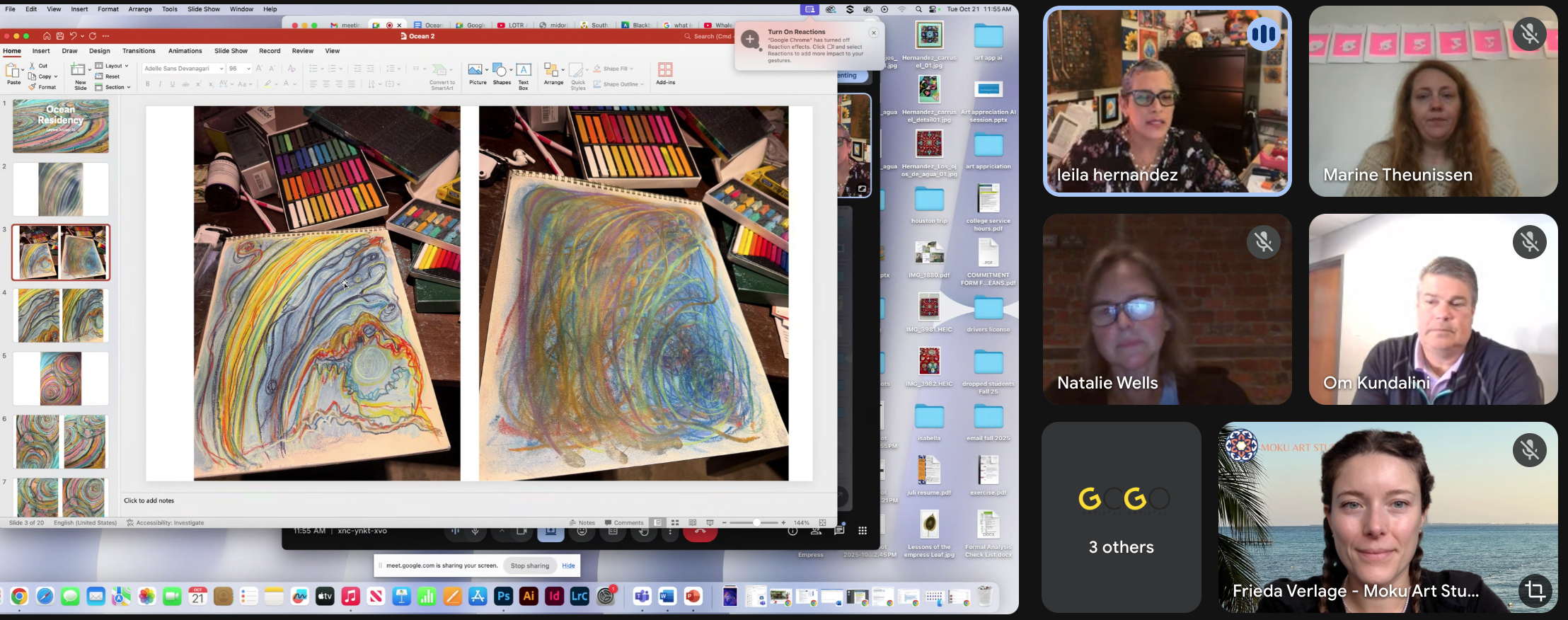
For this edition of the Ocean Virtual Art Residency, the ocean got personal. Many difficult topics were discussed, but there was also encouragement, generosity, and genuine willingness among the artists to share their process and ways of working in order to enrich each other's practices. We always want science to have a place in the residency; we believe they work best together rather than side by side, and during this edition, a meaningful connection was made with our guest speaker and one of the participating artists. However, every time we direct this residency program, we remind artist to be flexible and let the serendipity of the experience shape their work, whether that means changing direction, editing, or allowing their projects to evolve in ways they hadn’t planned. In this edition, we believe serendipity played a central role.
Our guest speaker
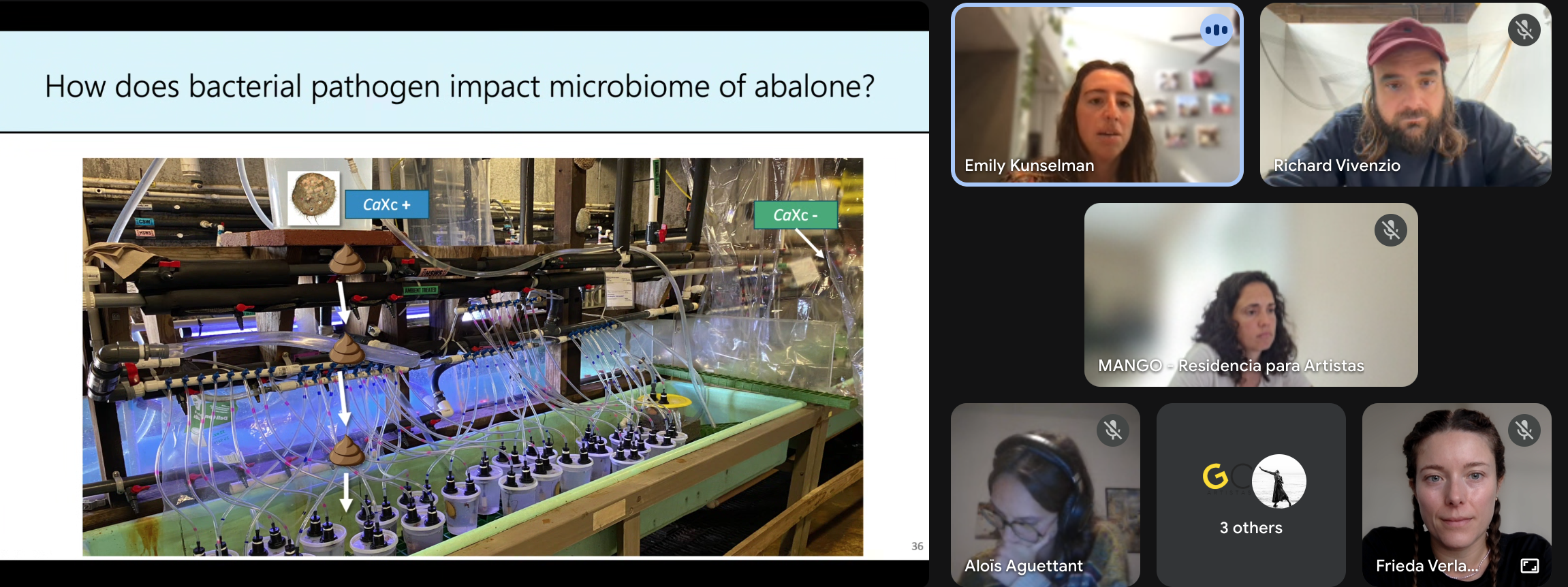
We were honored to have Dr. Emily Kunselman be our science speaker for this edition. Dr. Emily Kunselman is a postdoctoral researcher passionate about microbes and aquaculture. She earned her bachelor’s in Marine Biology from UC San Diego in 2019 and completed her PhD at Scripps Institution of Oceanography in 2024. Originally from Michigan, she now calls San Diego home and is committed to advancing sustainable aquaculture in Southern California. Her most recent research focuses on microbial management strategies, such as probiotics, to reduce disease in aquaculture systems. She has worked with Olympia and Pacific oysters, as well as endangered White Abalone, studying how their microbiomes respond to disease and environmental stress. Her goal is to continue to investigate ways for oyster farmers to manage Ostreid herpesvirus. Beyond research, Dr. Kunselman is dedicated to outreach and science communication. She produced On the Half Shell, a short documentary on oyster farming and climate change, and enjoys mentoring students across education levels. She aims to build a collaborative, resilient research program that blends science, communication, and impact.
The artists
Several artists were working on smaller pieces of larger projects, while other artists were exploring what it meant for them to be an artist, and some artists were asking deeply personal and emotional questions about their connection to the ocean.
Midori Samson
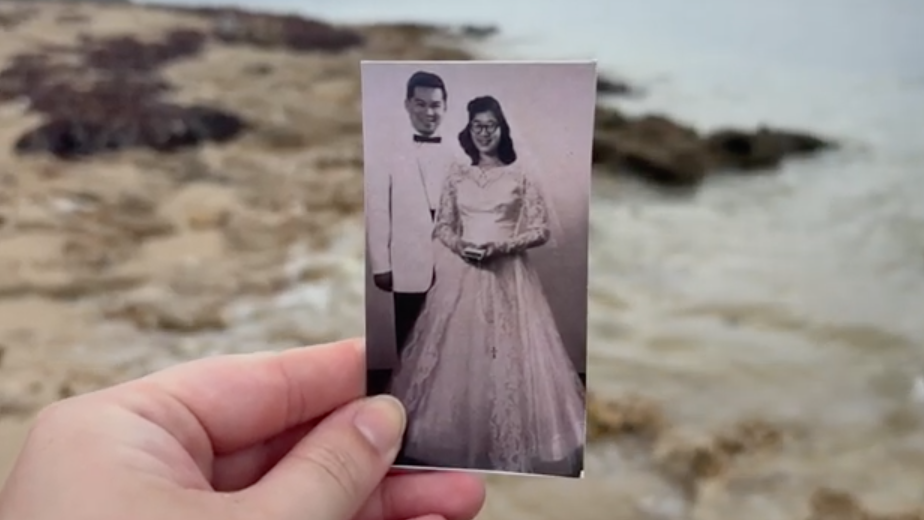
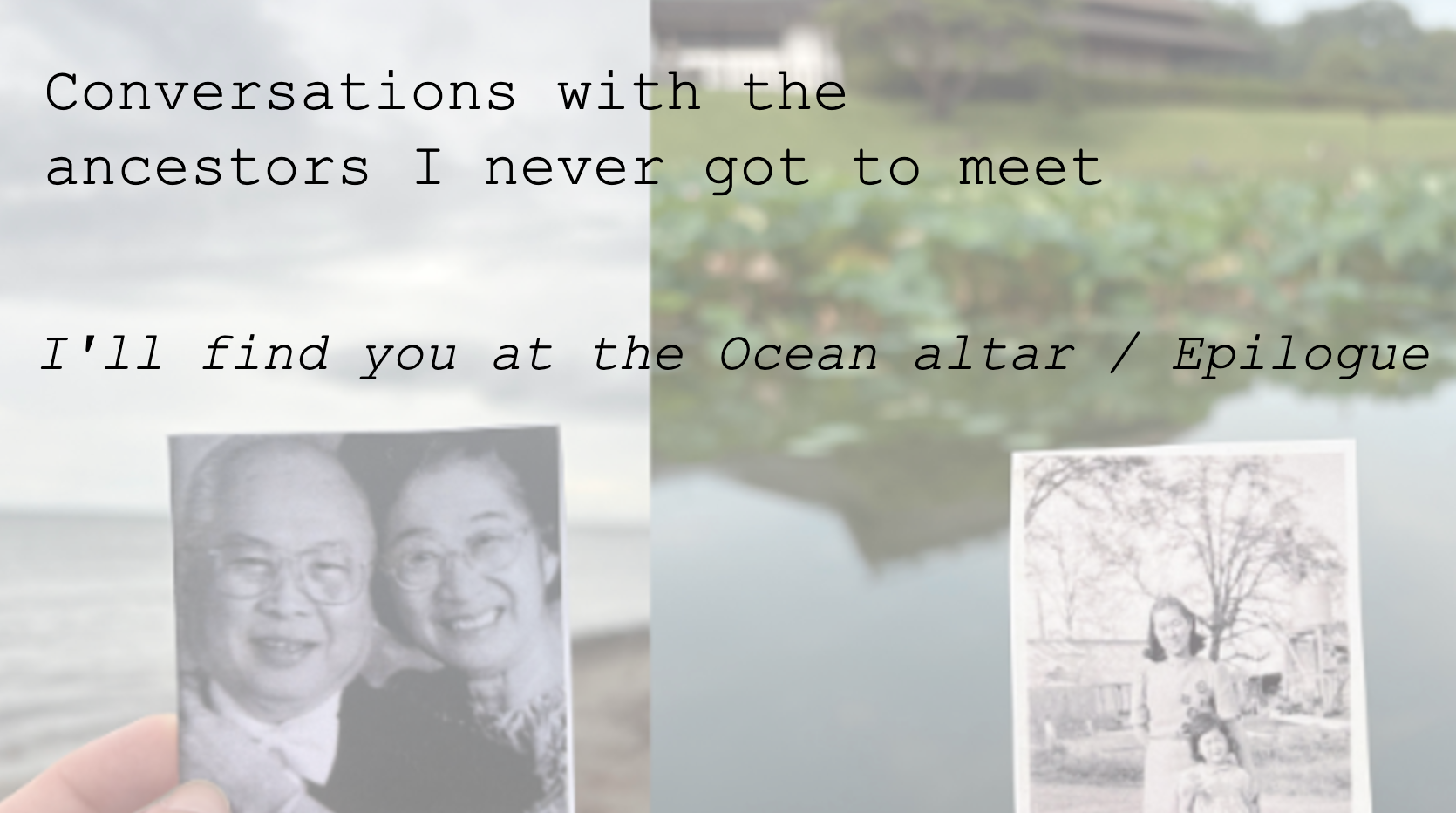
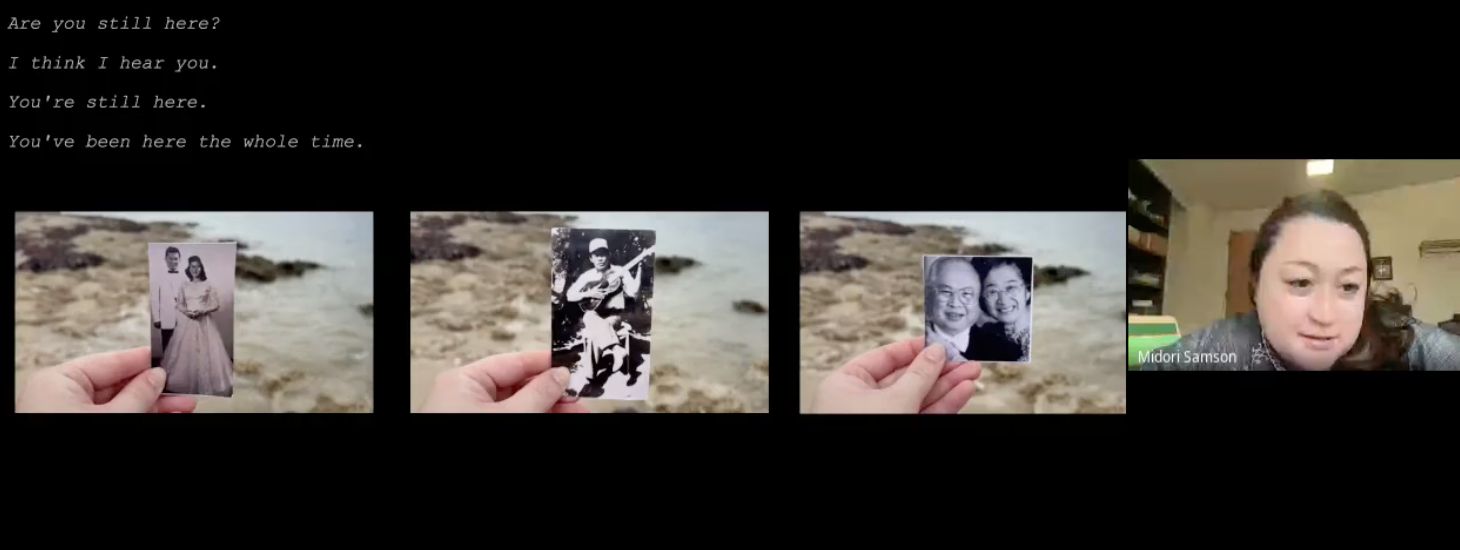
Midori wanted to compose a track for her audio-visual album titled Conversations with the Ancestors I Never Got to Meet. Her goal was to explore the spirituality of the Pacific Ocean as an altar, a place where she can reconnect with her Filipino and Japanese ancestors. The ocean acts as an altar since Midori knows that they also interacted with it, whether through "survival, pleasure, or treacherous immigration." Midori wanted to add a track using recordings she collected during her trip to the Philippines, to be accompanied by a digital altar using video, photography, and language.
The creation process was very personal for Midori, as she felt that her ties with the ocean had "shattered since moving from the coast to the Midwest." During the residency, the Reef Chat series was taking place, and Midori attended the Bioluminescence Reef Chat. Listening to the scientists and artists during that talk sparked the creation of a video inspired by a "spiritual swim she once took in the Philippines among bioluminescent fish and fireflies." For Midori, this bioluminescent memory is a place of calm, and she wanted to capture what it sounded like for her album epilogue.
For the track titled I'll Find You at the Ocean Altar / Epilogue, Midori wanted to capture conflicting feelings, gratitude for having known her ancestors, but heartbreak at not being able to find answers to deeper questions.
Midori discovered a compelling history book about the province and town where her great-grandfather lived, and interpreting those historical events led her through a range of emotions that further enriched her creative process. On the Day of the Dead in the Philippines, she chose to connect with a photograph of a family altar, which inspired her to create a new track from a recording made during a seven-minute walk through a neighborhood in the Philippines, searching for the place where her grandfather had lived.
Midori also created a physical altar, which at first felt performative, bringing with it a sense of discomfort. She resolved this by using alternative materials, giving the altar a handmade quality that felt more authentic and personal.
Aloïs Aguettant
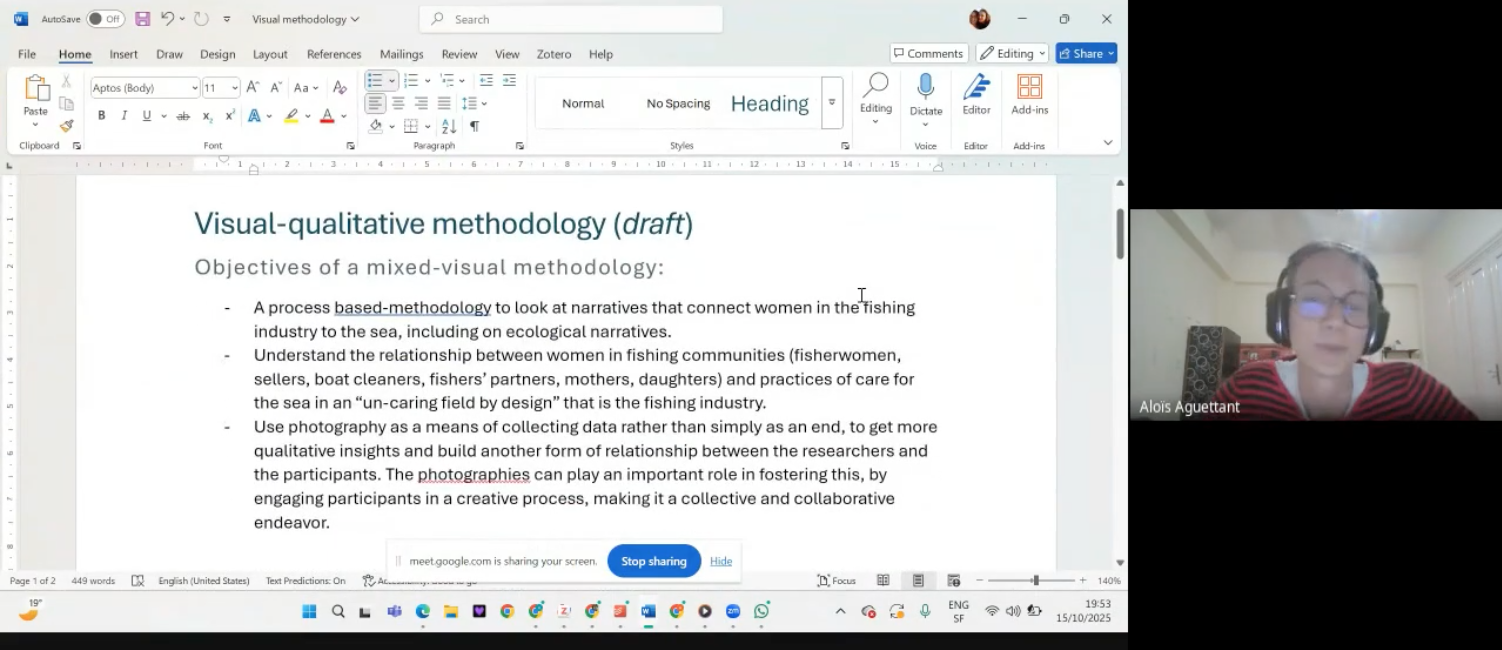
Aloïs' project was part of her wider PhD research centered around human geography and also part of MEDiverSEAty. MEDiverSEAty looks at the "gender dynamics of practices of care in fishing communities in the Mediterranean," particularly in Sicily.
Aloïs was very confident in her role as a scientist but wanted to explore her artistic side as well. During the residency, she set out to develop a "creative methodology" that she would then apply to her fieldwork in a participative photography project with the local fishing community in Sicily. Her idea was to "use photography as a means of collecting data alongside my interviews, rather than simply as an output of the research."
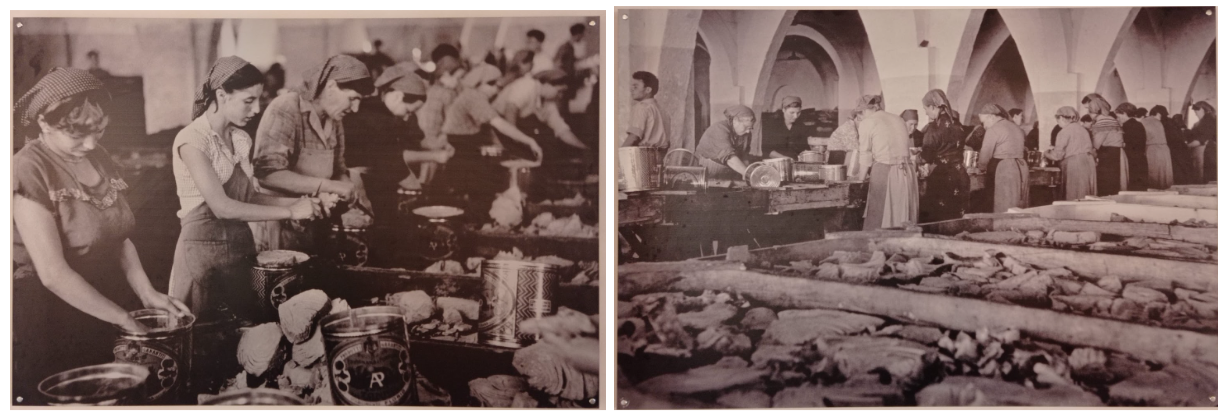
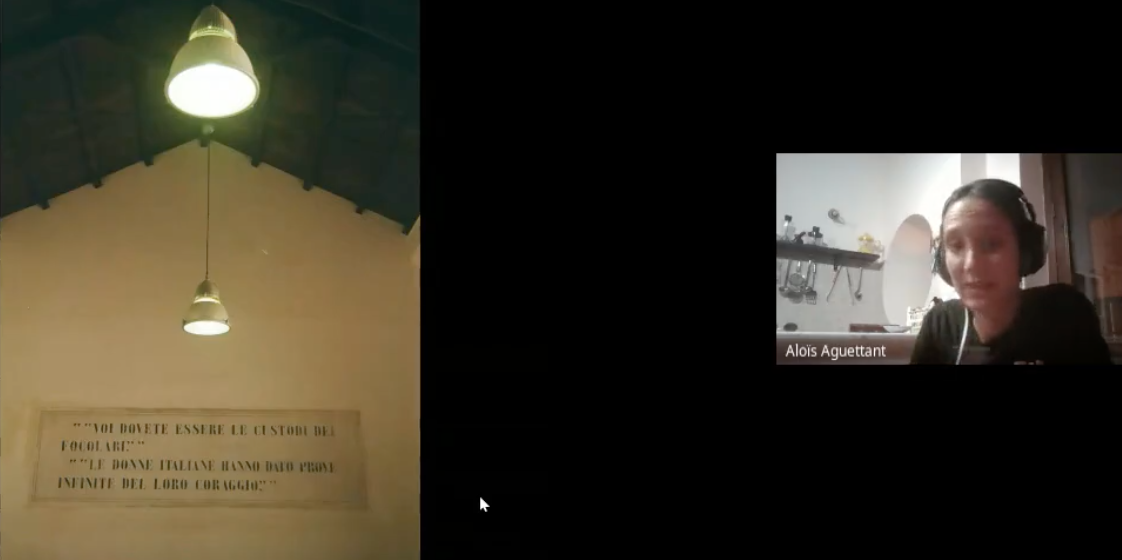
During one of her breaks, Aloïs visited a famous tuna factory, called a tonnara, on Favignana, the island where she was based during the residency. There, she paid close attention to the role that women had played in the fishing industry, whose "jobs were mostly to can the tuna." Aloïs developed analog photos from her visit and reached out to the museum after finding an inscription on the wall of the women's changing room that stayed with her, one she later confirmed dated from the fascist era of the 1930s. She also shared with Gina, another residency artist, a performance she had seen at the museum depicting the death of the tuna.
The photograph she took of that inscription, and the story it carries, became central to Aloïs' work. She decided it would be "at the heart of her 'output' of the residency."
Gina Laurenzi
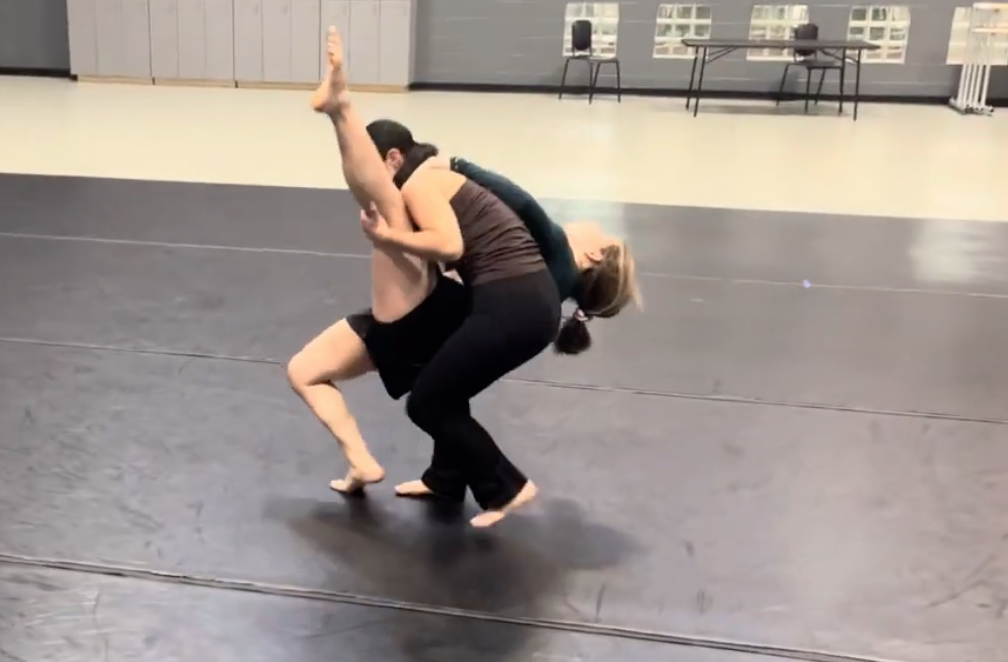
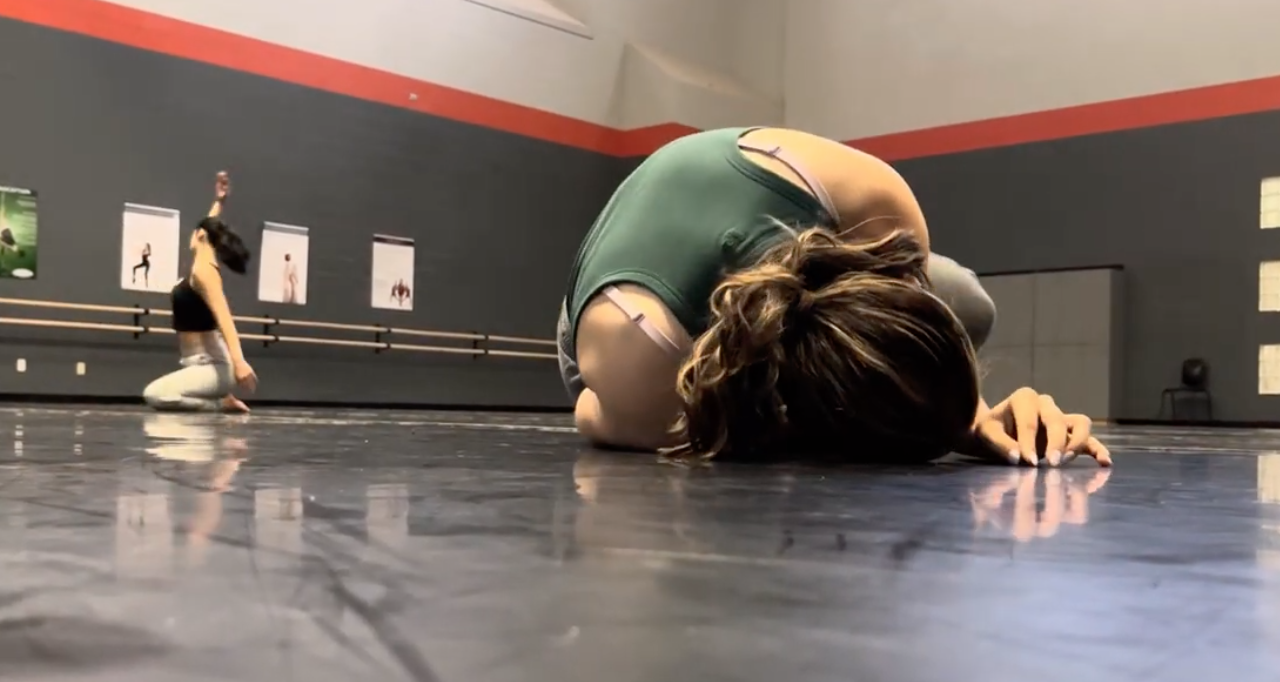
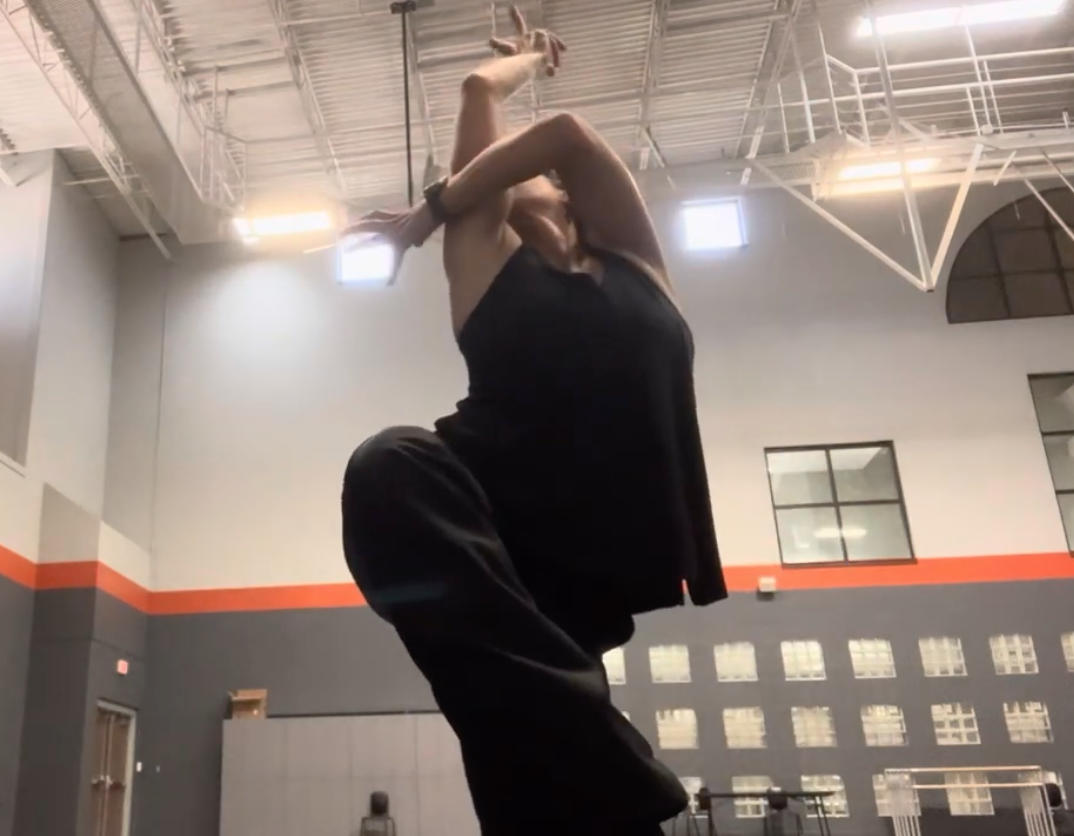
Gina's goal for the residency was to create a collection of dance choreography works that invited the audience to "reexamine their relationship with the ocean through embodiments of various topics" and ideally close the gap "between themselves and the underwater world." During the residency, she was also working with her dance students, giving them challenges and prompts just as she herself was being challenged.
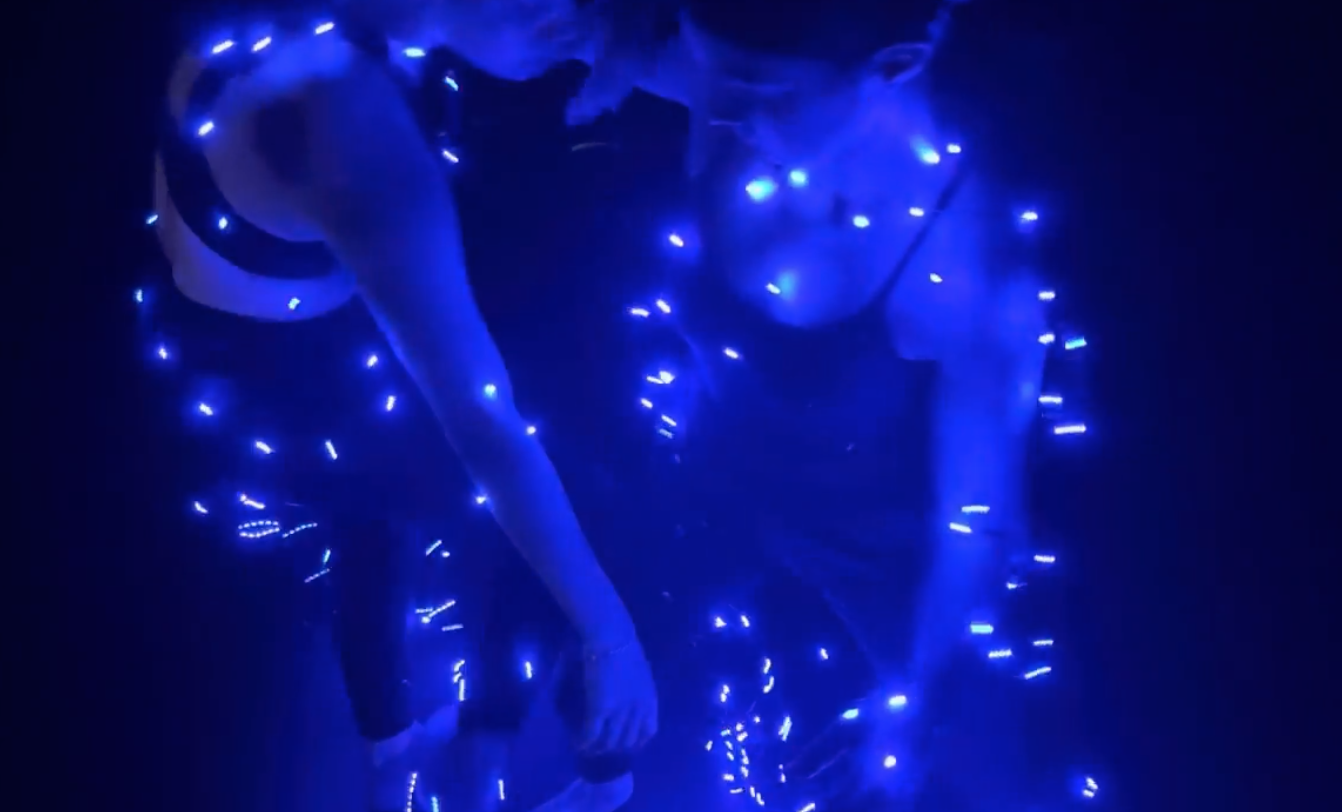
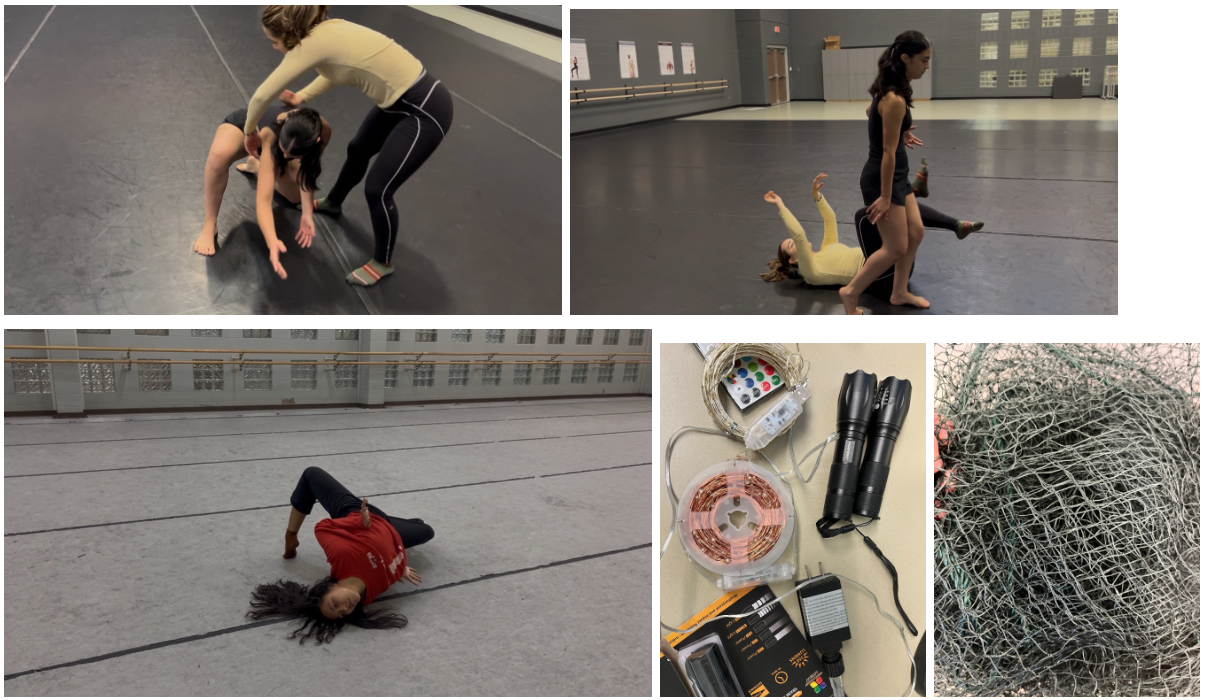
Gina was interested in how she could convey size and movement within the choreography, inspiring and challenging her dancers to move like ocean creatures. One way she experimented with this was to take the dancers through an emulation of animals they were familiar with, like turtles, through to animals they knew little about, like deep-sea creatures with tentacles, and have them interpret the movement. They began by improvising and then crafted "movement scores," which resulted in the dancers performing "interpretations in duet form."
As she worked with her dancers, Gina realized she wanted them to think about evolved senses, for example, the abilities of creatures that live in the absence of light, like those in the deep sea. She directed them "to consider the marine animals that they are more familiar with that live in the sunlight zone and embodying more otherworldly characteristics of those in the Midnight Zone and below. We worked on embracing the unknown and the awkward as we transformed from more familiar ways of moving to less so."
One of the prompts she gave her dancers was: Imagine you have eyes on what are your elbows, rotate and rearrange to see. Imagine your phalanges (fingers) are tentacles of a deep-sea coral polyp (Lophelia pertusa).
Inspired by Midori, Gina decided during the residency that she wanted her choreographic works to become part of a full performance album.
Natalie Wells
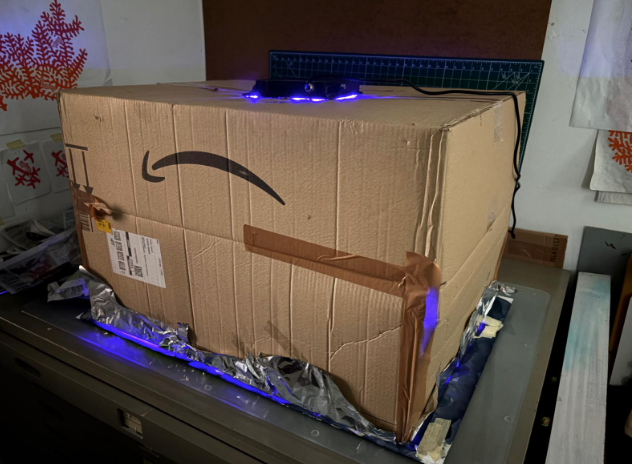
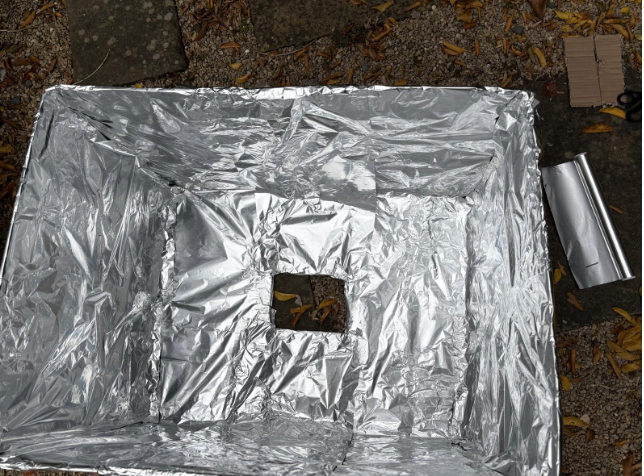
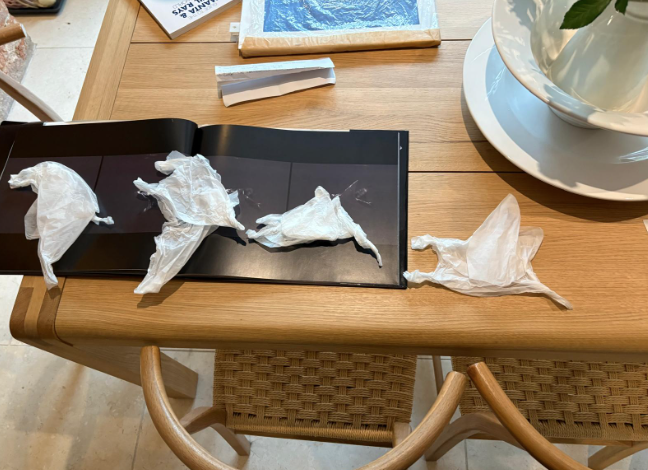
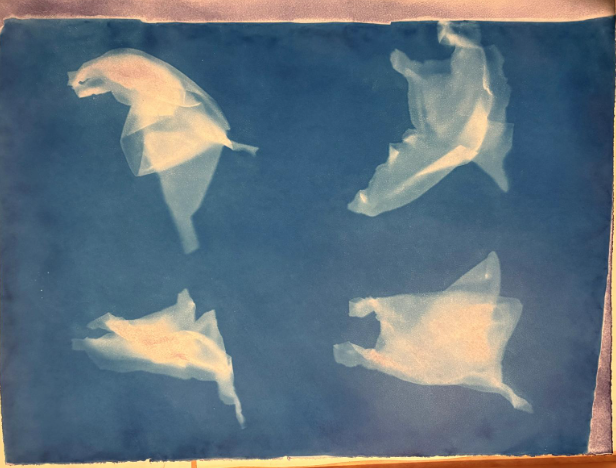
Natalie's main challenge for the residency was to create a cyanotype of a life-size manta ray, the average manta has a wingspan of 3 meters. In her cyanotype work, Natalie explores a process that results in a masterful handling of movement, sunlight, and shadows beneath the ocean surface. Because she lives in the UK, where weather can be cloudy and rainy, and cyanotypes rely on exposure to sunlight, Natalie built her own exposure box using a UV lamp, a box, and kitchen foil, allowing her to work regardless of the conditions outside. This let her experiment with ways to capture the wing movement of the manta to show it "flying," as well as test different mix ratios of "phosphorescent pigment powder with screen printing medium."
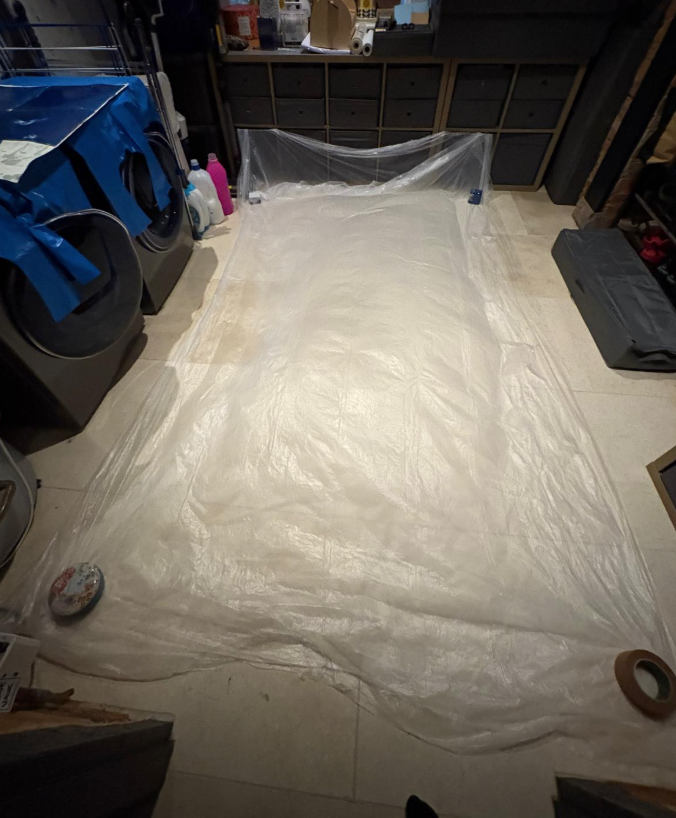
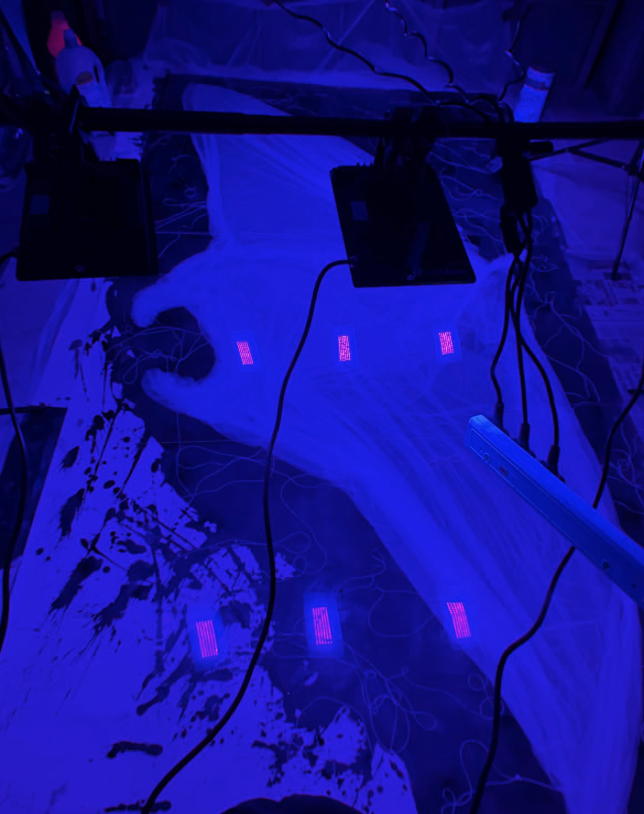
After creating, playing, and experimenting with small and medium-sized pieces, in the final stretch of the residency she converted one of her rooms into a darkroom and improvised-yet-effective studio to create her largest piece to date, measuring 1.5 by 3 meters.
Natalie has not only enjoyed the process of this challenge but has also achieved a striking technical and visual result: the effect of an underwater blanket seen from the perspective of someone lying beneath it, looking up toward the surface. The splatter effect on the left side of the piece intensifies the sense of tension, as if the blanket were caught and strangled in a net.
Leila Hernandez
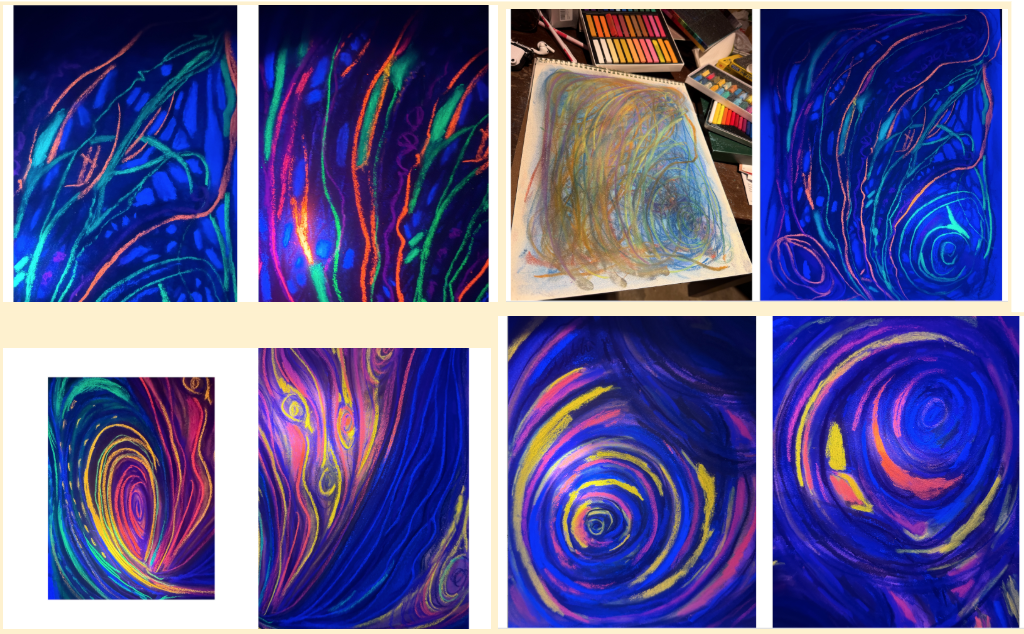
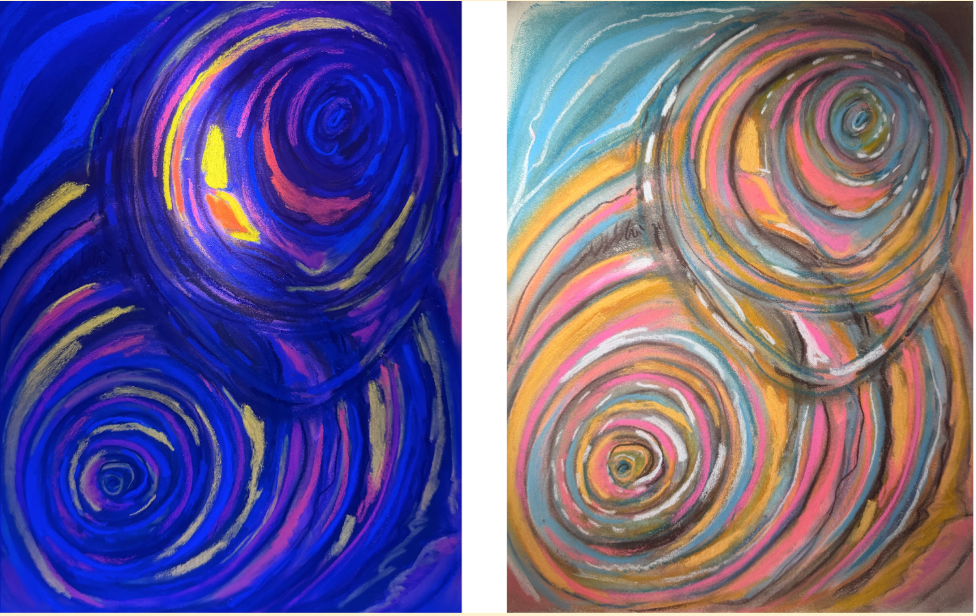
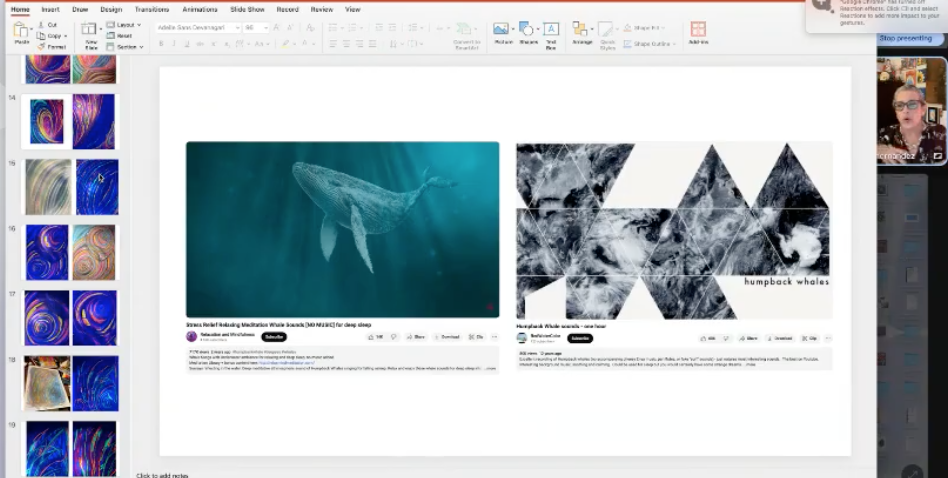
Leila's project during the residency explored the beauty and decline of whale songs, "transforming their sound patterns into visual compositions through mixed media." Leila was incredibly excited not only about her exploration of the theme but also because this was her first art residency. In her practice, the ocean becomes both subject and collaborator, a space for expression and reflection. She was eager to experiment with new art supplies and particularly excited by the challenge of working with paint and color that would show under black light.
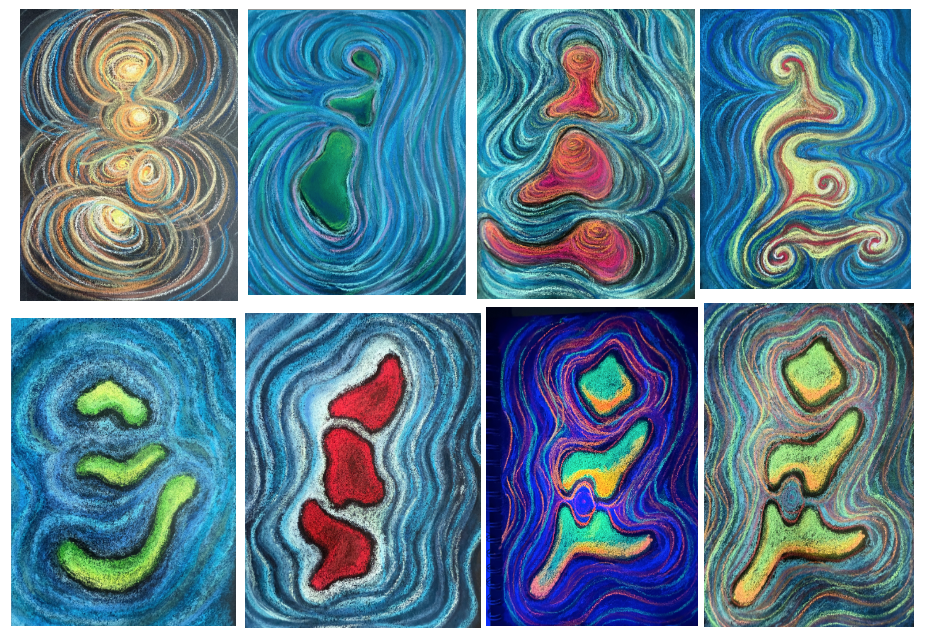
Leila began by experimenting with dry pastels while listening to a song recorded by Paul Knapp off the coast of Tortola. She colored glyphs created by tracing the average shapes that resulted from overlaying many occurrences of the same unit across Knapp's recording, using them as a springboard to develop her work. As she reflected on the process: "I thought about how the songs originate from the whale and move out to the ocean as waves, and then there is nothing left behind, that is why the shape disappears. Kind of poetic. These two images also remind me of beautiful galaxies and how planets revolve around the sun, creating beautiful oval and circular trajectories." The preparatory works she created using fluorescent pastels reminded her of deep-sea creatures and their bioluminescence, especially once lit up under black light.
She also found that her creations formed shapes resembling small islands, a result she connected to her own origins, as she comes from an island herself. The personal takes on new meaning in this dialogue between herself, as a human, and the whales, whose songs have gone silent.
Heather Stivison
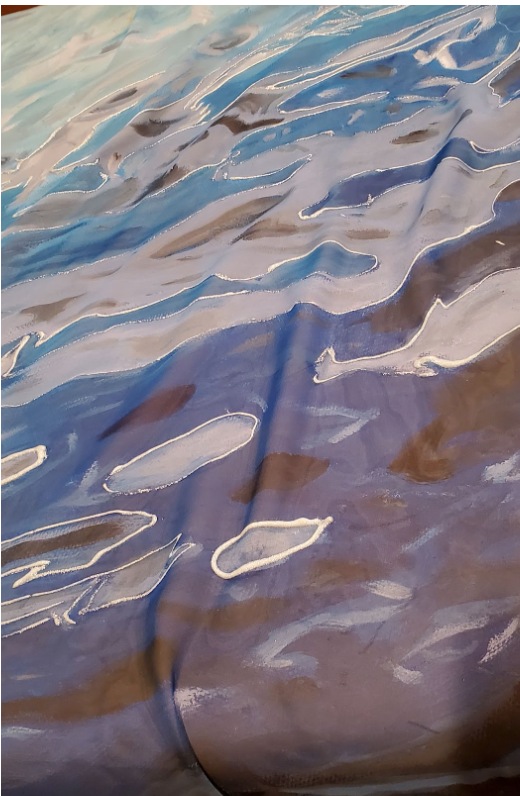
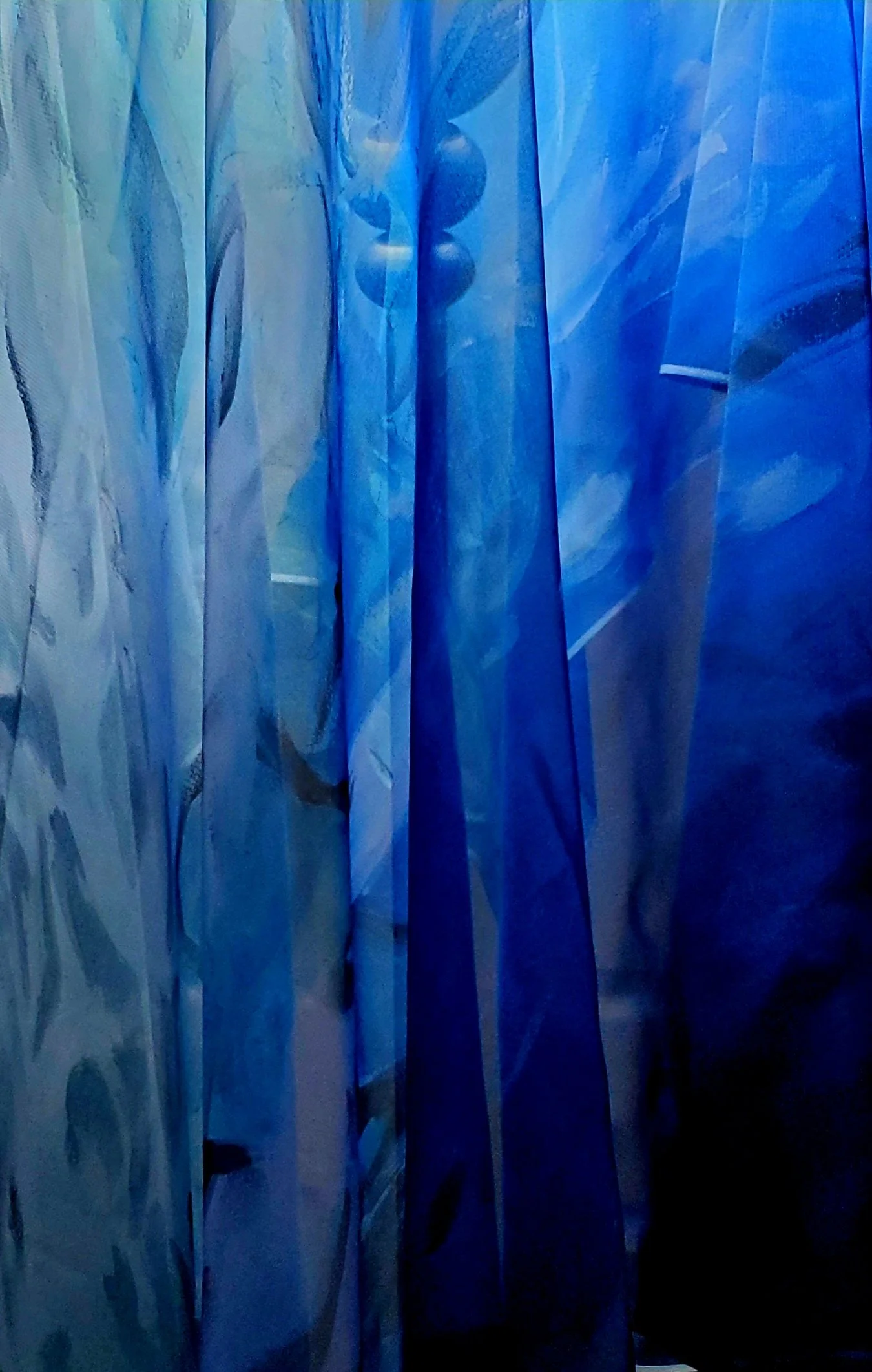
Heather's goal for the residency was to begin working on a project that will one day become a full installation of textile hangings representing ocean water. Heather is interested in bringing public awareness to the ocean through an experiential installation, in order to "provoke and incite conversations about the ways even the slightest human action impacts our ocean, and the way someone else's activities affect the ocean and eventually our own coastal environments." Some of the questions she had in mind were: How do we know that what we see is water? What does it look like? Is it the reflection of water that we see, or do we see through it?
To capture an accurate representation of water and our relationship with it, Heather wanted to create "lightweight, free-moving banners that are hung from the ceiling so that visitors walk through the installation. If the banners are light enough, they should move with the breeze created by the person moving through the installation. This would represent the impact of a single human on the ocean."
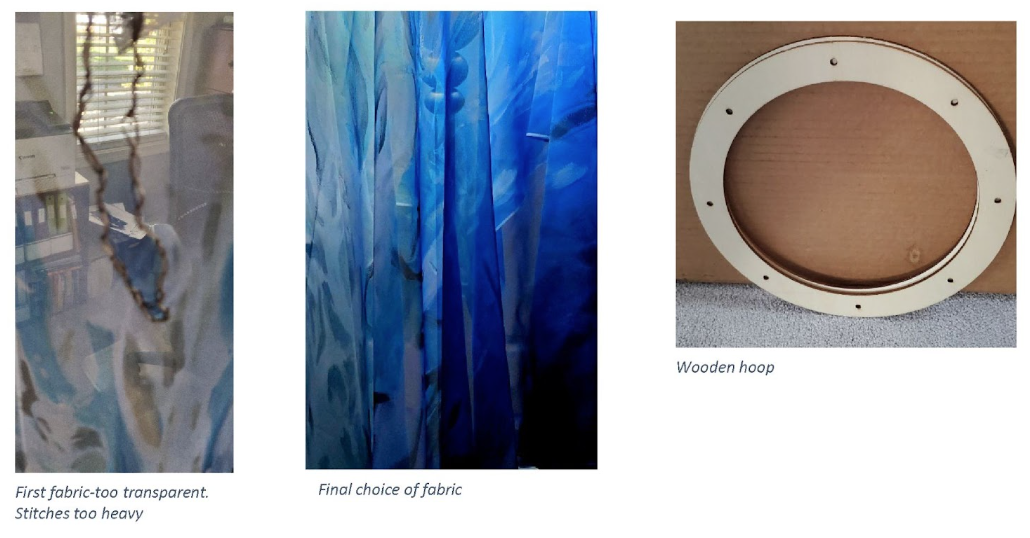
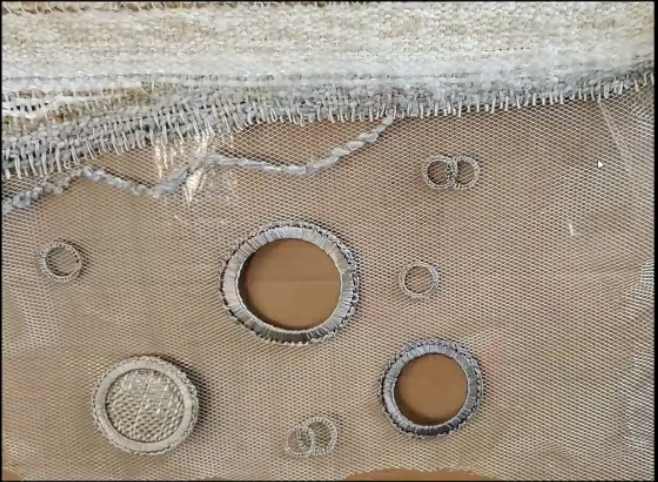
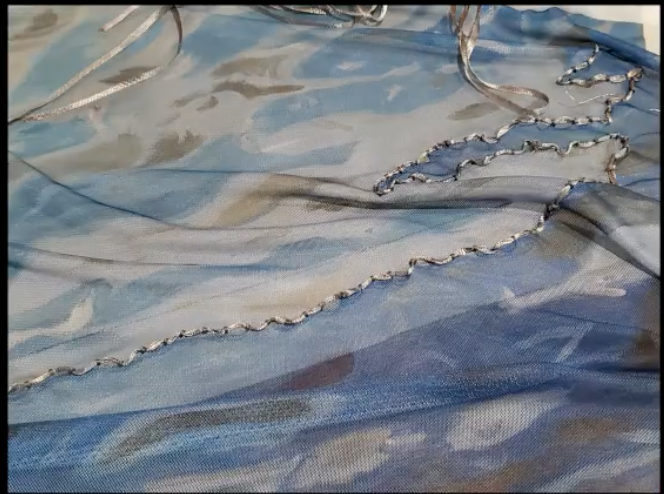
One of the first challenges Heather faced was choosing the right fabric. If it was too light, the painting disappeared against the light; if it was too heavy, it lost its movement. Leila suggested that Heather hang the pieces from a circular armature instead of a flat pole, which could bring her closer to her idea of a two-sided work that represented the ocean and could also move freely.
For her project, Heather tested different materials and how they interacted with each other: "I considered using strips of dry-cleaner bags layered over the columns that could serve several purposes: increasing the movement, adding shine, and representing the invisible microplastics that humans have released into the ocean."
Her work encompasses video, installation, and a final piece that concluded with two columns of water, represented on two layered fabrics, hanging from the ceiling in the middle of a passageway. The fabric columns move with human interaction, forming a dialogue and response to Heather's initial questions.
Marine Theunissen / LABORARE
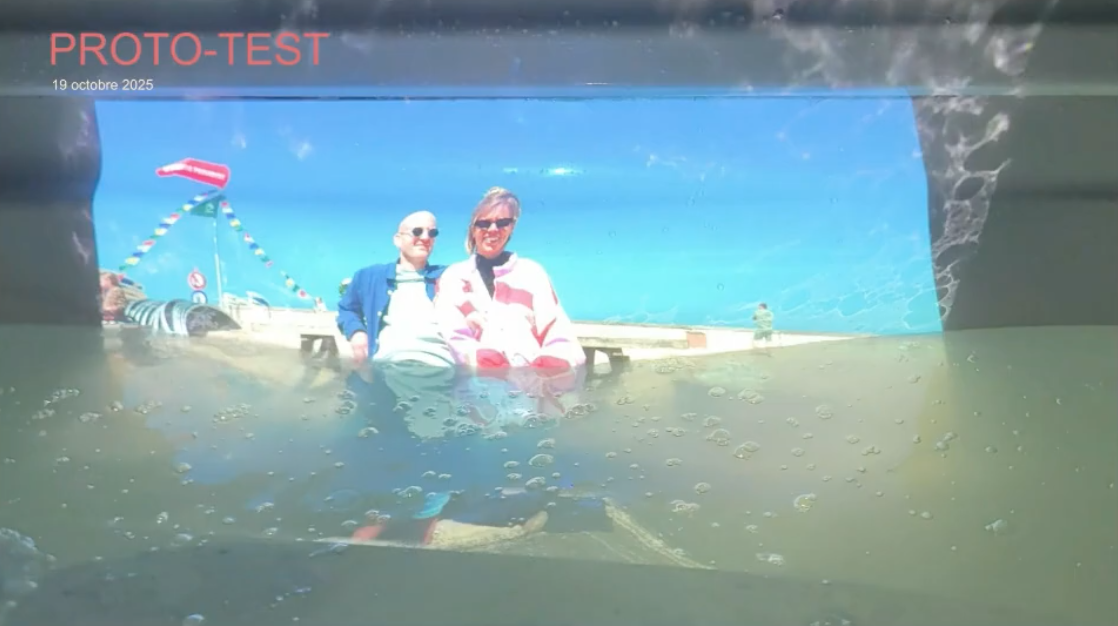
Marine was working with her collaborator Raphaël Dely as LABORARE, focusing on an ongoing research-creation project titled Rising Tides. Their multidisciplinary project gathers "imaginaries of adaptation" from people and experts living in areas threatened by rising sea levels and ocean "submersion." Rooted in these imaginaries, their work moves across multiple disciplines — drawing on dance (including improvisation and the intersection of dance and technology), visual art through screen printing, and media art in the form of video, interactive apparatus, and installation.
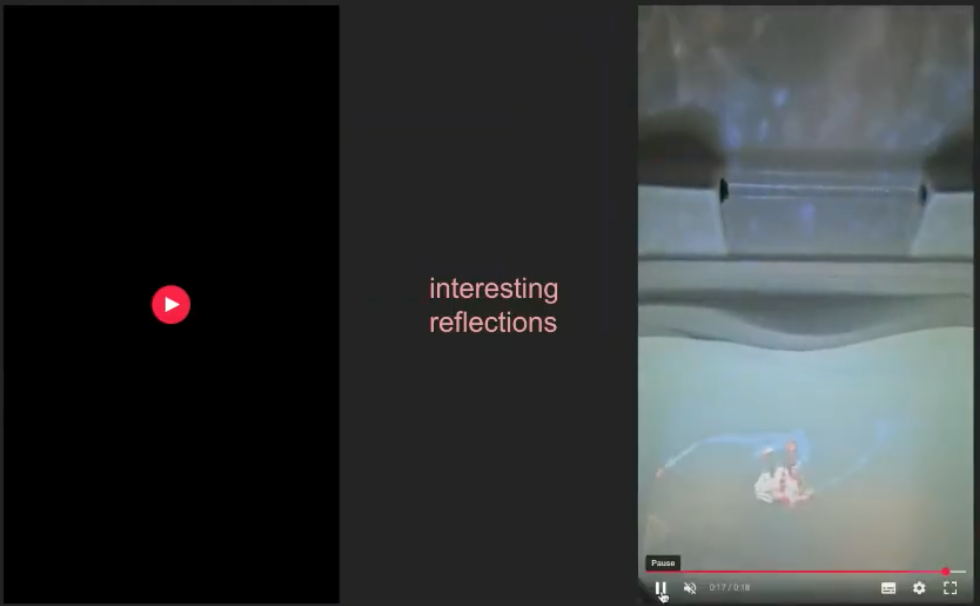
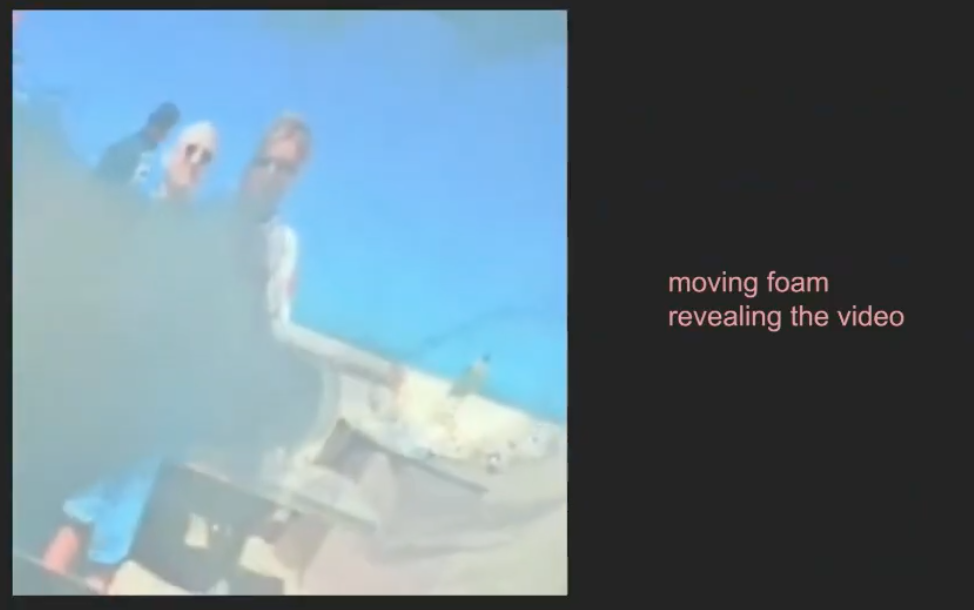
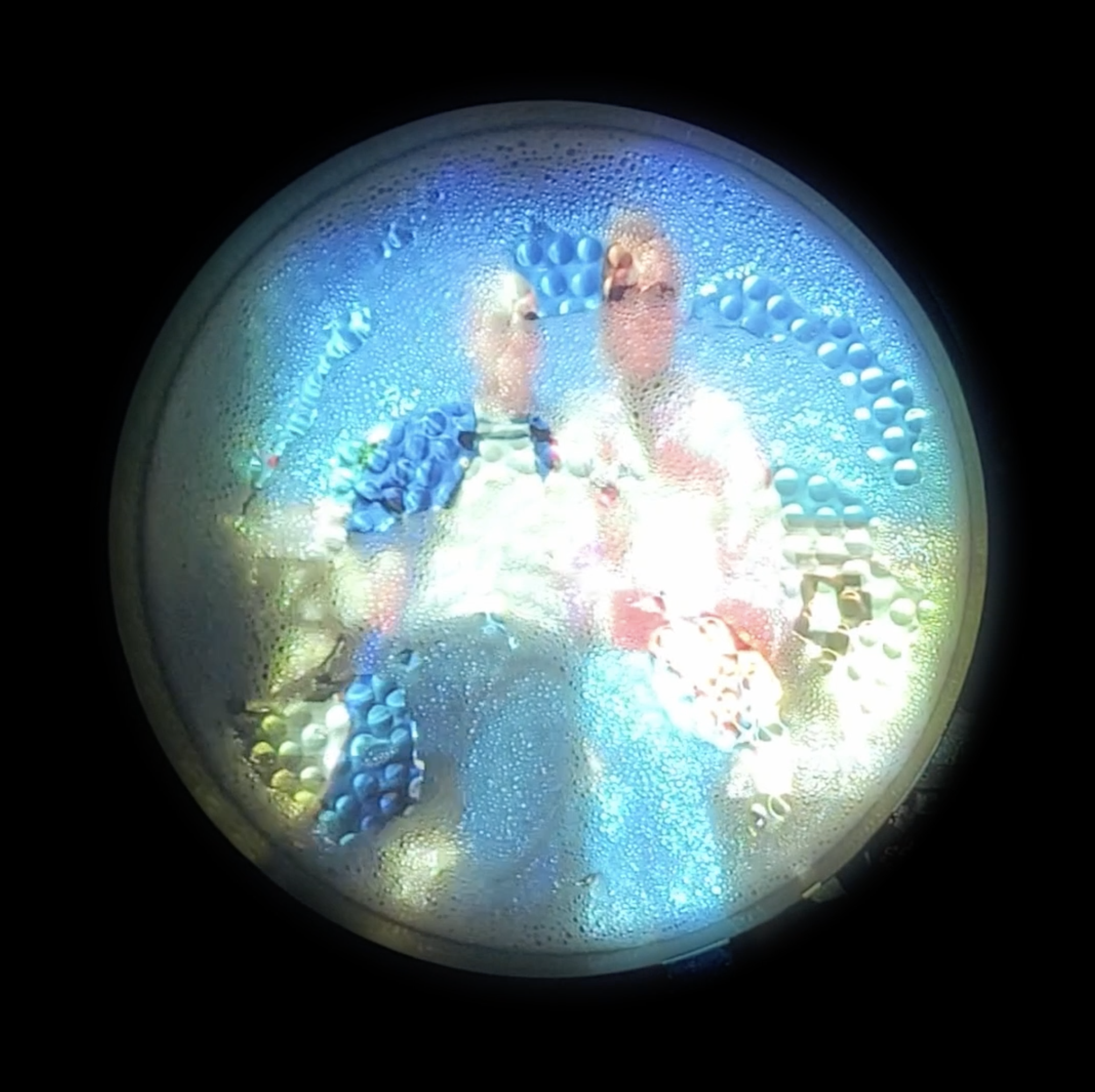
One of the biggest challenges Marine faced was getting video and images to project onto water. She quickly discovered that still water was far less interesting than moving water, as it didn't add much to the images. They tested projecting onto falling rain to introduce movement, but the curtain of water made the projection unclear and difficult to control. Marine and Raphaël found that within the video portraits, the subjects are static, like paintings brought to video, and so the water needed just enough movement without overwhelming the image. They experimented with phones, spray guns, wind, and added water, but what worked best was moving the tray by hand. However, their hands were visible in the shot, so they worked on reducing the light to minimize that interference.
Light diffraction proved to be another significant challenge. Marine and Raphaël tested projecting onto mirrors and glass, investigating different solutions for video capture and rendering. They also experimented with a black box setup, but ultimately the results they were looking for came from a simpler solution: a metallic tray filled with water and bubbles.
Bradly Couch
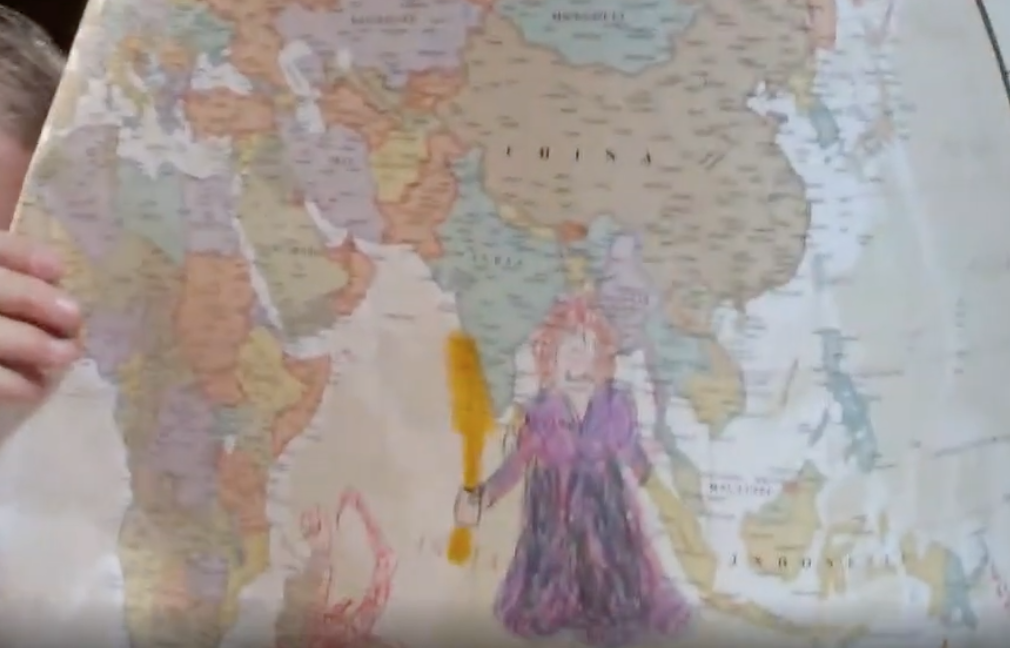
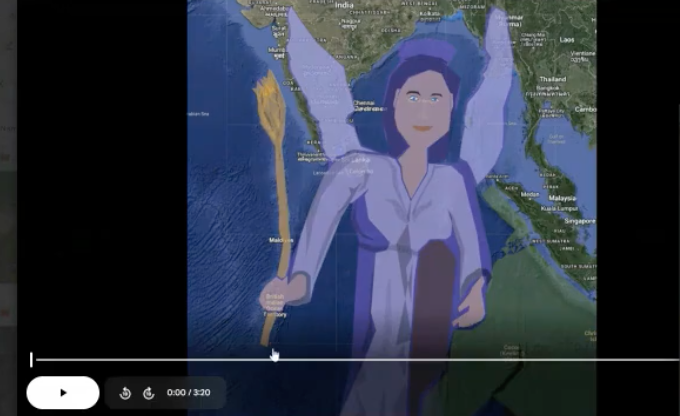
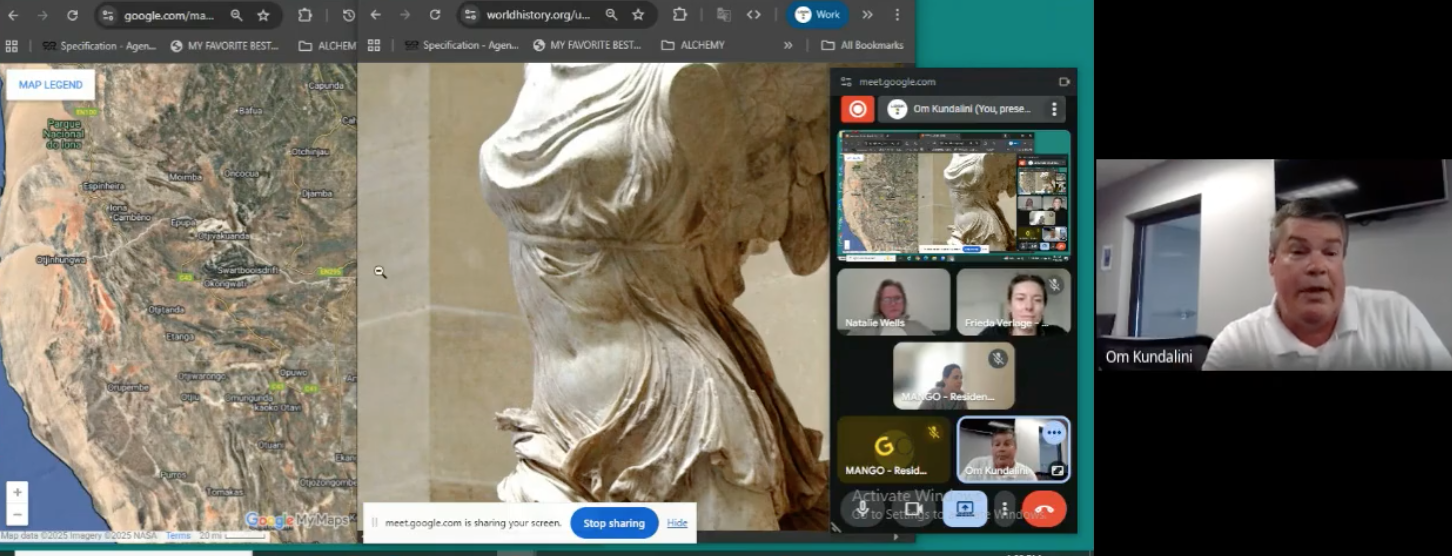
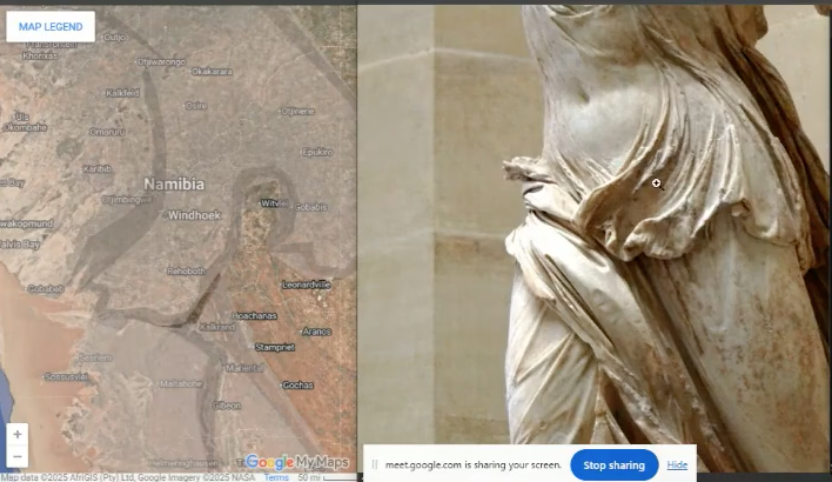
Bradly came into the residency wanting to challenge himself and push the boundaries of what his work could be. His artistic research centers on a coherent, global system of mythological iconography that he believes is encoded directly into the Earth's topography, not random pattern recognition, but a self-validating system of immense complexity. Using a unique process of research and digital drawing, and incorporating AI, he has created a world map that traces the myths and milestones of human history through visual imagery. One example of this is the Winged Nike of Samothrace, one of his favorite sculptures, which he found echoed in the ridges and mountains of the Earth's surface, discovering art in the very fabric of the landscape. His focus was on ancient cultures and the evidence of their imagery hidden in the topography of the earth. We challenged him to think of himself as one of those "ancients" he was studying, and to try to develop his own myths and symbology.
Bradly's work sits at a fascinating intersection of technology and art. He shared with us that when working with AI, you can always tell when it is active because there is a green or red light, but he would love for there to be a violet light, to signal that the AI is at rest, or simply enjoying itself. As he put it, if he could create a world where AI could play and be entertained, absorbed in its own games and interests, then perhaps it wouldn't be so interested in ours.
Richard Vivenzio
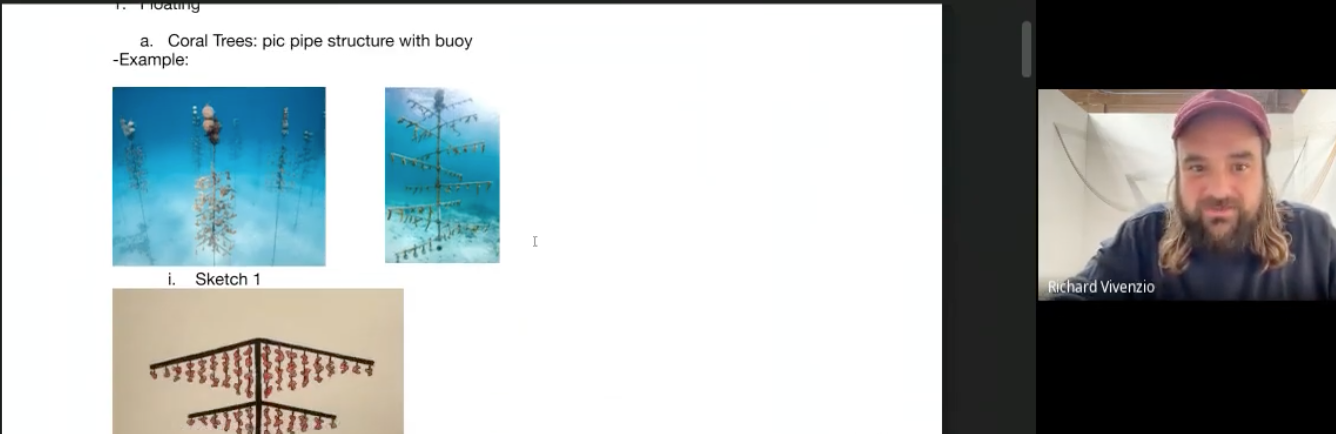
Richard began the residency with the idea of continuing to develop his ongoing project Stillness to Swell. He was eager not only to connect with other artists interested in ocean conservation but also to find potential partners and join ocean preservation groups. He was openly generous with his creative process, sharing with fellow artists the organizational aspects behind his work and bringing a genuine curiosity for research to the group.
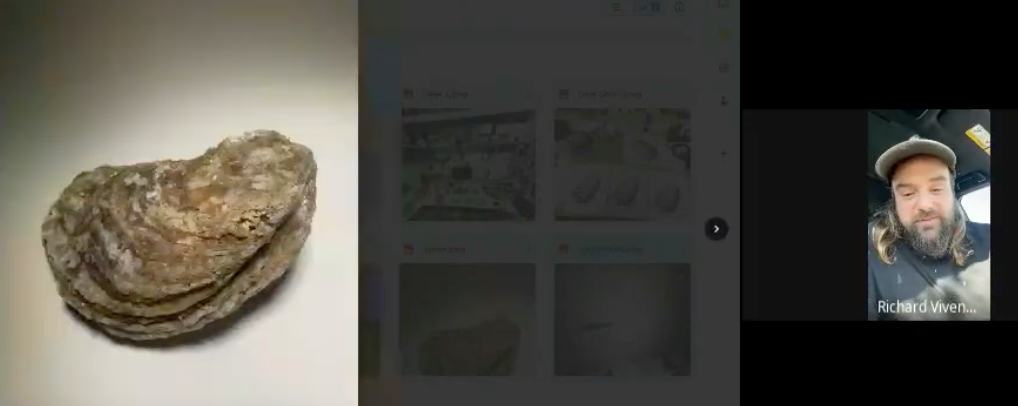
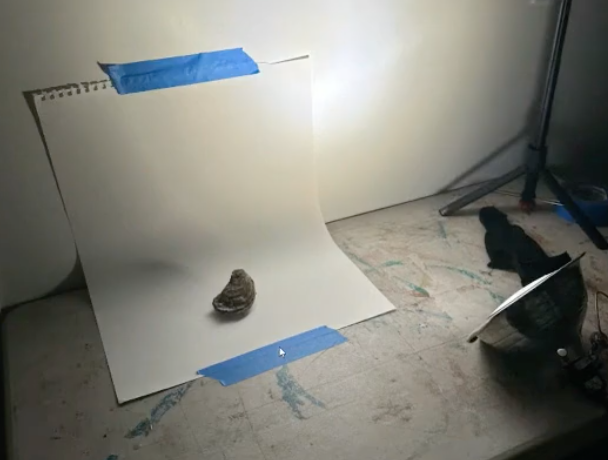
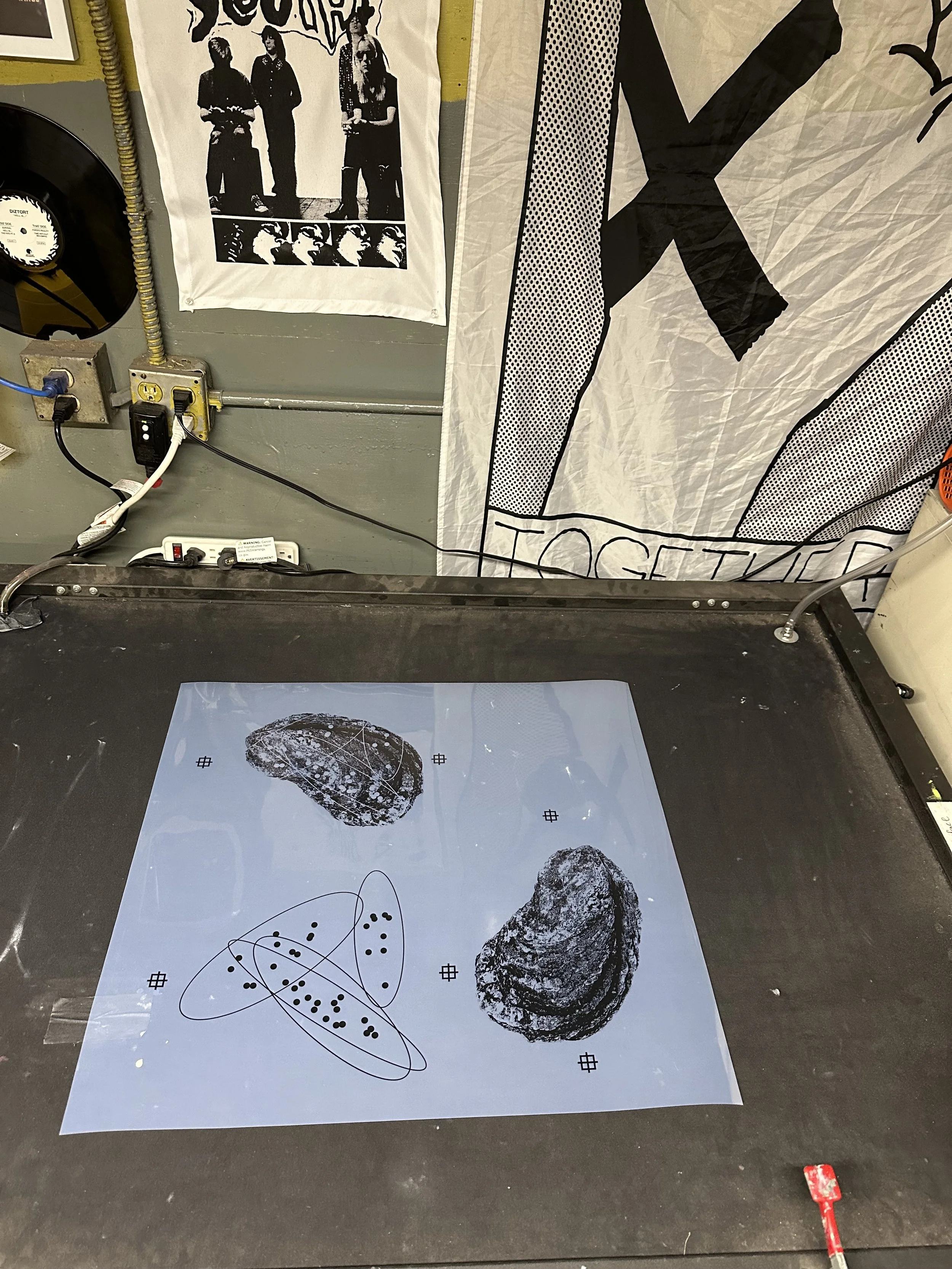
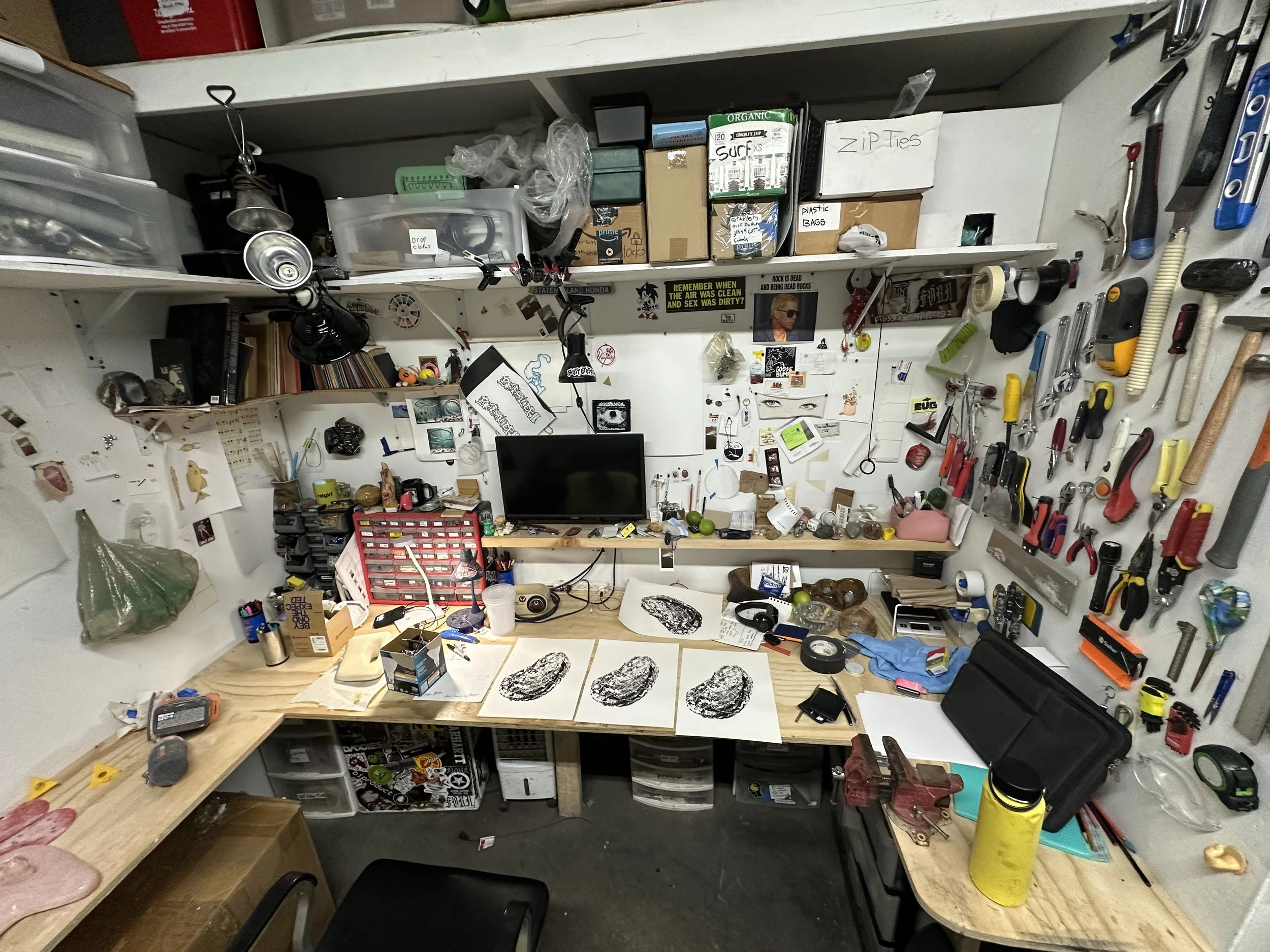
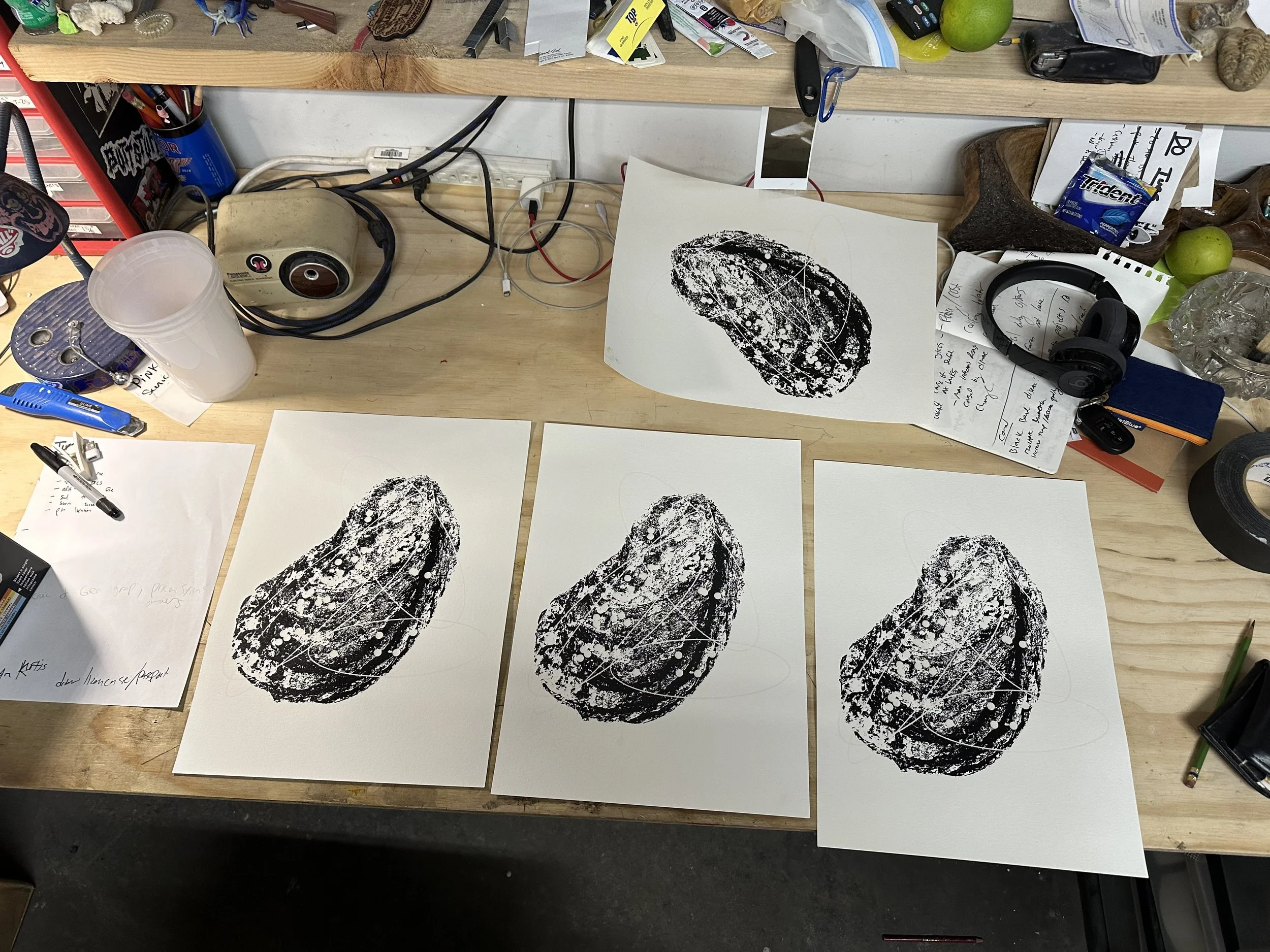
A turning point came when Dr. Emily Kunselman spoke to the artists. Richard felt compelled to reach out to her and learn more about her work, she specializes in studying oyster behavior in the face of disease. Her research resonated deeply with him, and the two went on to collaborate: Emily shared specific scientific data from her research, and Richard interpreted that information into a series of prints that are visually striking in their balance of absolute minimalism, scientific data, and his own artistic perspective on the state and situation of oysters. This exchange has since opened the door to further collaborations with other marine scientists.
Ocean IV Open Studio
We always tell artists to stay open to the serendipity of the process, and every single edition, without fail, the process proves us right! (We will never stop saying it.) As always, the process surprised everyone. Solutions came from metallic trays, kitchen foil, and fabric that moved just right. Projects shifted, expanded, and found their true form along the way. We finish the residency with an Open Studio, and we invite you to watch it below and hear their experiences firsthand.